Posts

How safe is your domain? 28th March 2013 11:56 AM
“At the end of the day, it's all a bunch of coding so these things are always going to happen. ”

I think it's the alleged ease of the exploit (and the fact I've got domains with them )

“anyone with a hosting package from 123-Reg, and hence an account control panel, simply had to change the final section of the URL manually (to, for example, /someoneelseswebsite.co.uk) to be able to gain access to another site's emails, name servers and billing”

“I have never used, encourage or endorsed the use of Analytics over web server stats.”

Personally I'm the total opposite

I'm a big fan of Analytics, and with the exception of Google moving to https which screwed up some of the keyword data, I think the combined reporting tools of analytics, adsense, and webmaster tools is powerful, quick, gives you good snapshot visibility and the ability to create customised reporting for your own circumstances.

Parsing server logs trying to get rid of the bot traffic is tedious, and a lot of the data can be very misleading to the inexperienced.

My biggest thing with server logs is the high visitor numbers, which sound great, but paint a false picture. Server logs are supposed to differentiate between human and robot traffic by looking at the useragent, ie are you a human using a browser or a web crawler. But there are now so many crawlers out there, a lot aren't picked up by the user agent.

Coincidently I was having this same chat with a local business who was telling me about the 100's of visitors he gets a day, but was struggling with any conversions. I've offered to help out as a favour, and saw the site had no SEO, page titles were "post1" etc, so doubted the traffic numbers.

Installed GA the other day, and have been comparing against his server logs. Here's yesterdays results, the top is server logs, the bottom from Google Analytics.
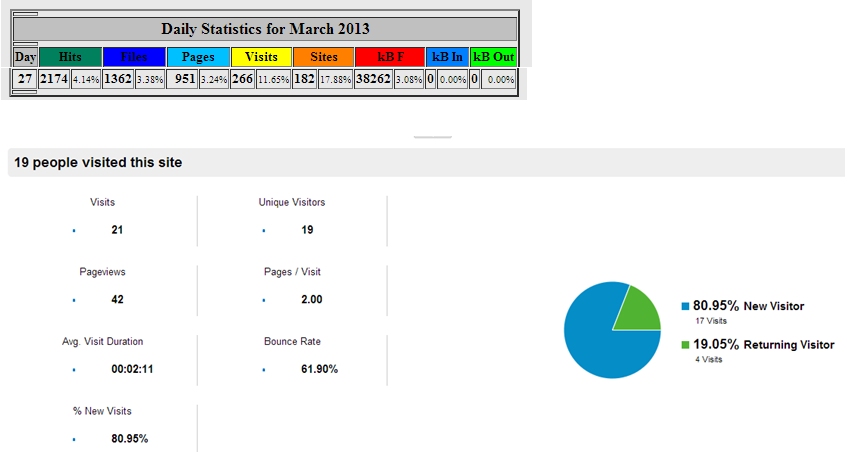


So according to his server logs, he has had 266 visits on 27th March.

According to GA, he had 21, of which 19 were unique.

Then there is the old 1990's favourite stat the "hit" which has to be one of the most abused stats ever used in telling people how popular your site is.

Looking at the state of the site, I think I'd believe GA.

Unless I can be convinced otherwise! Personally I'd love a compelling argument that GA stats are rubbish and server stats are accurate, because we base our own numbers on GA. According to our server stats, every house in the UK has visited My Local Services at least once in the last 30 days!

GA also has it's flaws, obviously it's javascript, which may be disabled on your pc, or the code may be at the bottom of the page and not fully load before the visitor clicked away, but if put in the header, and forgetting javascript blockers, I think it gives a pretty good picture.


Back to the OP, the SEOmoz article is a good one, and there is some good stuff in your server logs you can't get from GA, as the examples with the logon page highlighted.

But for day to day health checking, research and running reports, I can't imagine life without GA.
Interesting stuff, this takes DDoS attacks to a new level. We used to deal with them regularly back in corporate days, but then it was normally a case of blocking selected IP's from perimeter firewalls and problem solved. But times have moved on, DNS is more flexible which looks like it can also be the problem.

I guess it will be lessons learned, and any recommendations for tighter protocols normally come out of attacks and exploits, which will be the way of the internet and computing in general.

But back to your question, good publicity for Cloudfire, but interesting the attack bypassed them once the attackers realised the approach wasn't working. But all major ISP's can deal with this, and the natural resilience of the net will unsure the network stays up. Just unlucky if your website happens to be on a server on an impacted segment.

Eventually, no doubt it will all be distributed load balanced websites (cloud) so in theory impact would be less as traffic would be rerouted to a resilient cloud network or partner, as your site pops up somewhere else.

For now though, quite happy with my physical servers and a decent back up
How safe is your domain? 27th March 2013 4:39 PM
Came across this today:

300 UK domains pilfered, MASSIVE security lapse blamed
“What appears to be a glaringly obvious security hole has been blamed for the snatching of 300 domains hosted by one web-hosting firm last year...”

Scary stuff, from a so called old timer in the hosting and domain world. Just adds fuel to the fire of internet security arguments...
Finally, I got sent some chocolate! 27th March 2013 2:36 PM
We had a thread recently about sending chocolate as a marketing gimmick, and it seems a few companies now have latched onto the idea.

Well our marvellous and quite frankly very generous forum hosters, nimbus have sent me a bar of chocolate, so now I'm happy


So this is an interesting approach, as we are already customers, which would make this a bit of customer services PR, as opposed to being used to generating new customers.

Anyone else had any recent choccie bars or marketing gimmicks?

<anyone else who wants to send me chocolates, please feel free, or beer works quite well>
The VAT Inspector 27th March 2013 10:51 AM
Woohoo VAT Inspection!!!!!

Remember the drill, put the wrongly claimed amount for
Google+ just changed! 27th March 2013 10:40 AM
“The cover photo is now massive, then you get the circle in the corner which looks completely out of place.”

Good tip from Neil to reduce the size of the cover image:

Here's my revised effort...
“Which one works better in your opinion.”

It's horses for courses, different things work for different industries.

Online has distinct advantages in speed to market, measuring success, with complete granular analytical data down to which exact campaign / site/ source / keyword worked for you.

Things like PPC can even be instant marketing, and you can get measurable data within minutes.

People that see your adverts or services via online sources tend to be in a conversion mode at that moment in time. Something caught their attention and they responded to what ever advert they saw and performed an action on your site. This may be nothing more than a visit, an enquiry or a sale. But this entire journey can be tracked, analysed, and processes amended if need be.

I see offline as aimed at a different customer mindset. They are not normally in a buying mode, and more of a browsing mode. It may be a bill board on the way home, an advert on a bus, a flyer in your free paper, or an advert in the press. It may be a catalogue or a book of vouchers that is kept and acts as a reference for a future sale.

It's a powerful form of marketing, builds brand awareness, familiarity, and can be a good source of sales, but as already said it can be also be hard to track.

Until you've tried and experimented with different forms of on and offline marketing, you won't really know what works best for you.

A local landscape gardner may make a killing from local flyers pushed through local letterboxes, and have no need for a website let alone online marketing. An online only retailer may have a limited spend and is happy with just a PPC campaign which works for them.

One of the best off line marketing spends we've had recently was a pop up banner. Mixed with a few flyers, and biz cards it give you a pretty cost effective presence if you attend local business shows.

Successful marketing normally comes down to a blended approach, and you utilise different techniques that work for you developed over time and hard won experience
“Blogging has become a new career to some of us these days. People have different approach as to why they blog: some blog just for fun, while others blog to earn a living.”

Technews? Have you been living under a rock for the last 10 years?

I think blogging has past its zenith and I wouldn't be looking to blogging for a career change!
Stolen content 25th March 2013 10:49 AM
A good result all round

Shall close the thread...